
Ryoji Ikeda is an artist who crosses visual and sonic media, he focuses on the characteristics of sound itself and the visual as light by means of mathematical precision and mathematical aesthetics and has been working on long-term projects through live performances and installations. Several of his works are now on exhibit at the Estonian National Museum, that I was able to visit recently.
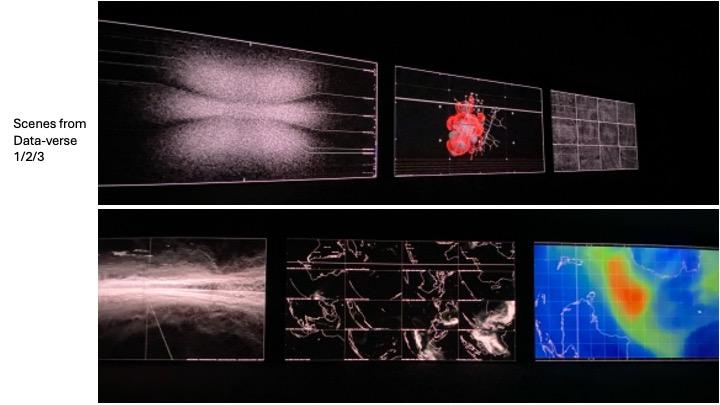
Data and its aesthetic/sonic visualization play a central role in Ikeda’s work, and he has worked with gigantic sets belonging to CERN, NASA (the National Aeronautics and Space Administration of the US) and the Human Genome Project. Shown in Estonia, Dataverse 1/2/3 is the result of this ongoing project encompassing the datasets, rearticulating the raw data into digital artworks through his mathematical compositions. “This audio-visual symphonic suite attempts to encompass all scales in Nature, from elementary particles to the Universe.” … “A minimalist electronic soundtrack is harmonized with Hollywood standard, high definition 4K DCI video projections of scientific data onto a large wall screen. Immersed in this vast data universe, visitors are invited to partake in and confront the massive data flows in which we live, as well as challenge their ways of apprehending and experiencing the world.” (from the accompanying guide to the exhibition). Two other works shown, Vox Aeterna and The Critical Paths, are commissioned specifically for the exhibition as part of the European Capital of Culture Tartu, 2024 program.
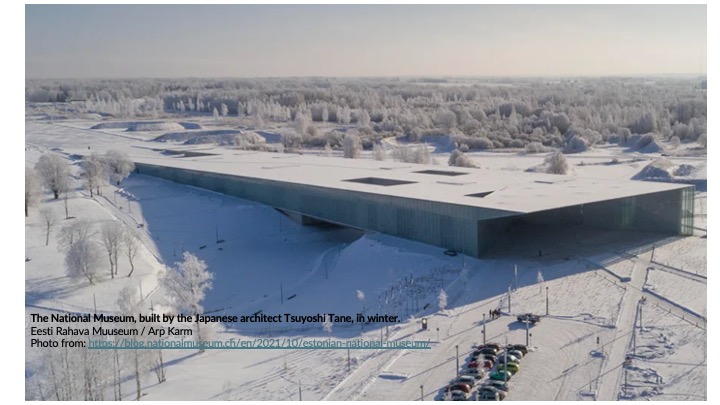
The Estonian National Museum is an ethnological and culture-historical centered museum, focused on collecting, preserving and enabling access for study the culture history of Estonians, Estonian minorities and Finno-Ugric peoples. In its new building that opened in 2016, it houses two permanent exhibitions, Encounters, looking into the past, present and future through peoples’ lives and experiences, and The Echo of the Urals,experiences, materials and knowledge of the peoples of Northern Eurasia. The building itself is an elongated futuristic-looking building appears to protrude from what was a former military airport runway. Entering the grand hallway one crosses a large performance space, coming to three main exhibition entrances.
Having visited an earlier exhibition of Ikeda’s work (Eye Filmmuseum, 2018) and remember being very impressed, I was now particularly interested in and drawn by the idea of the collaboration that underpin the new works. I was less prepared for the museum setting in which it is shown, but now, after some time to think about it, it turned out to be an unusual experience. It is also an eye-opener of richness of histories I know so little about, despite my training as an anthropologist.
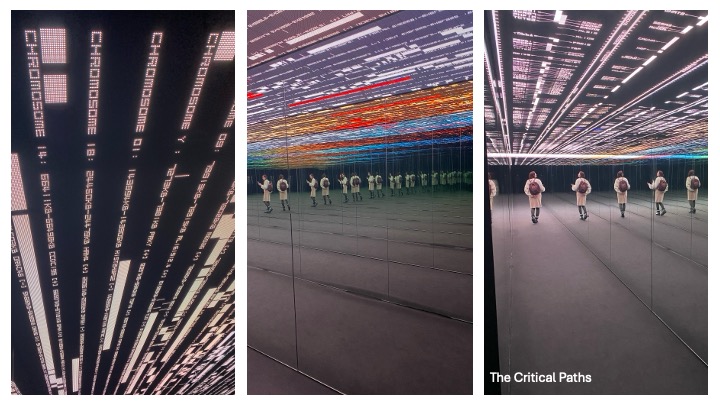
The two groundbreaking works that are commissioned as part of the European Capital of Culture program are inspired by the history of the Estonian people. In Vox Aeterna, “eternal voice”, or “timeless voice”, Ikeda takes the voices provided by the Estonian Philharmonic Chamber Choir as raw material and transforms these into a multi-phonic composition for a 9-channel speaker system. For Critical Path, Ikeda collaborated with scientists of the University of Tartu Institute of Genomics. It uses DNA of people living today and those who lived in the past in Estonian territories to create an audiovisual installation, rendering the evolutionary history of our species in a new way.
After spending some time with Ikeda’s dazzling data, I enter the Echo of the Urals. Although I am not completely charmed by the exhibition the design that reminds me of old panorama’s, I am pleasantly surprised by the content and context. Echo of the Urals, relates the culture, stories, languages and relationships between different groups collectively indicated as Finno-Ugric indigenous peoples, without their own statehood, who inhabit an immense swath of land from Scandinavia in the northern part of Eurasia and the Baltic Sea to the Taymyr Peninsula and Yenisei River in Siberia.

At first, Ikeda’s work and the ethnographic exhibition appear to be worlds apart, and as for the motivation for showing Ikeda’s work I can only guess, however it opens up an interesting perspective, merging metrics and myths, the physical and the digital, elucidating stories and patterns that are part of our worlds colliding, creating a novel point of departure for crossing and dissolving boundaries.
What I am still curious about is how the collaboration between Ikeda and the scientists developed: How are the data processed? Do the scientists gain new insights in their data through this collaboration? and other questions remain open. I did try to contact the leading scientist before my visit to gain more insight, but without response.































 Sense-ible Bag Lady